| PID | 645565 |
|---|---|
| MIDI | Yes |
| USB port | Yes |
| Arpeggiator | Yes |
| CV/Gate | Yes |
| Sequencer | Yes |
| Number of Keys | 0 |
| Polyphony | 16 |
| Built-in Display | Yes |
| Battery operated | No |
| Manufacturer address | Lilienthal Str.7, 53424 Remagen, Germany |
| Manufacturer's email address | |
| Manufacturer name | Waldorf Music GmbH |
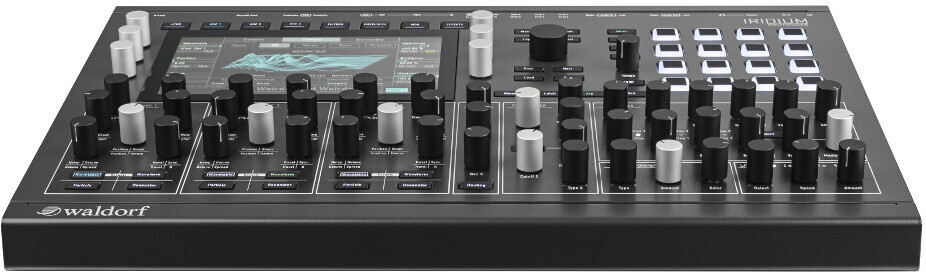
The well-known massive, orchestral wavetable sounds that defined the entire 1980s soundscape and broke down the barriers between classical music, chart-topping hits, entertainment, and film music are now available with all the modern features and in a compact rack-size package: the Waldorf Iridium! Iridium is part of Waldorf’s legacy, which began with the PPG Wave, but at the same time, it is one of those versatile modern synthesizers that master all synthesis forms with ease and can combine them in ways previously unimaginable. It is like the flagship Waldorf Quantum model, but a smaller and more convenient module that fits into a rack or on a tabletop.
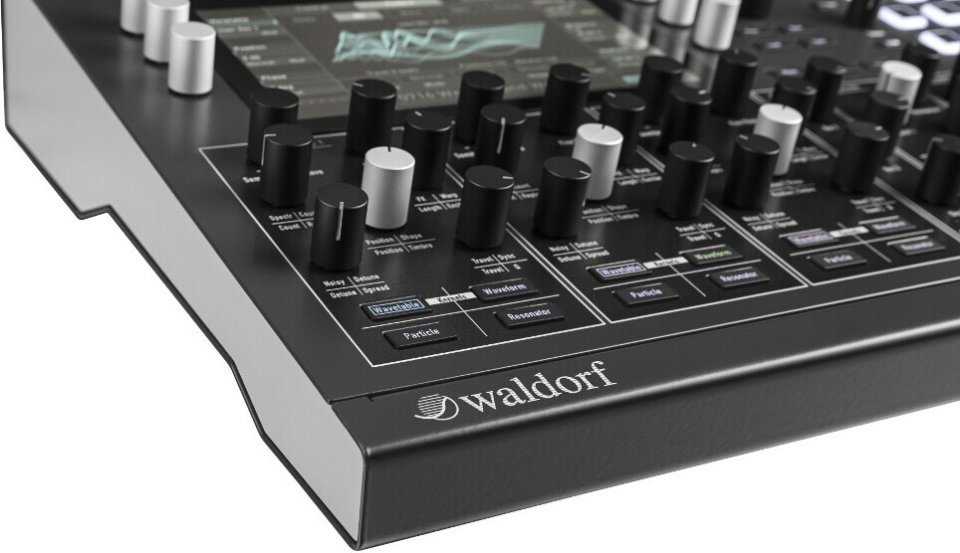
Waldorf Iridium offers five different synthesis types for each of its three oscillators:
– Its own original wavetables, of course in an expanded and enhanced version
– Virtual analog, meaning classic oscillator-based waveforms, also thickened by combining multiple waves
– Sampling and granular sampling with both traditional sample functions and multisamples
– Resonator for demanding, virtual sound sculpting into shape
– Modular Kernel synthesis, where up to six audio cores can be freely combined into a single oscillator
Kernel synthesis was first introduced in the Quantum operating system update 2.0, and with it, each oscillator can be divided into six sub-oscillators that are then linked via FM synthesis as audio. This is already an impressive new instrument in itself, whose usage possibilities are still being explored. Waldorf Iridium has 7,000 memory slots, fully compatible with Quantum. Each voice has three digital filters: two freely linkable in the Dual Filter section and one in the Digital Former section. These include low-pass filters with overdrive, Nave, Largo, PPG 3V, as well as more unusual filters like Comb, Drive, and Bitcrusher. All filters preserve a natural, authentic stereo image throughout the signal path.
The modulation matrix with 40 slots can be controlled by much more than six envelopes and six LFOs. Each slot can be assigned a separate control value, and modulations can be routed to almost anything that can be expressed numerically. Internal inputs and outputs can be reused repeatedly until the matrix is full. And if the LFO or envelope runs out, the Komplex Modulator is available for creating new filter shapes.
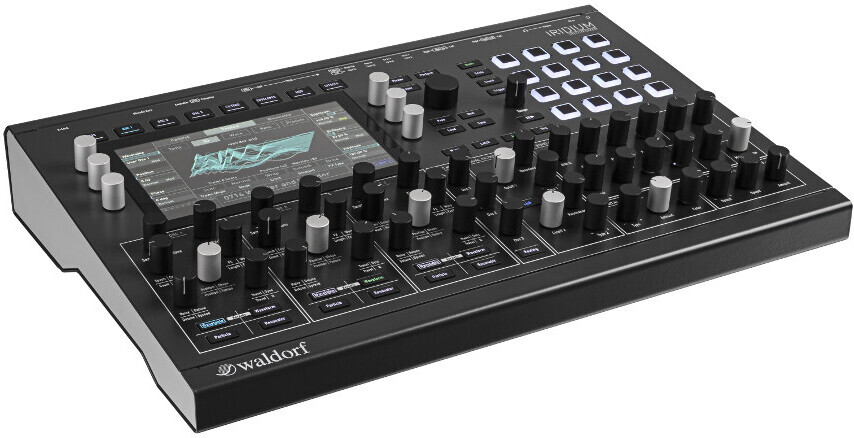
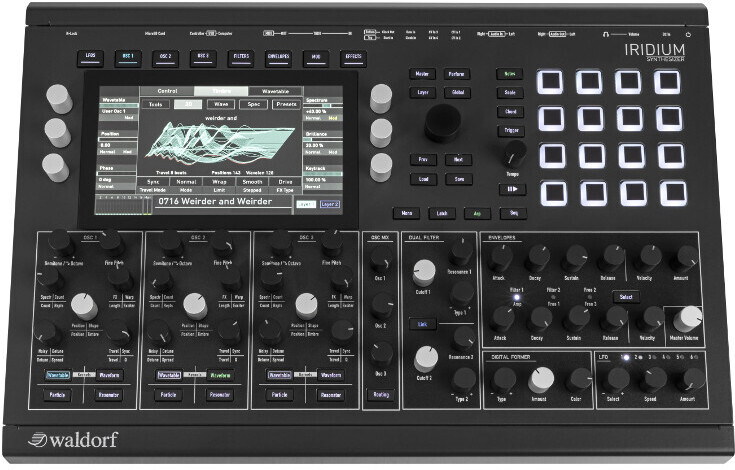
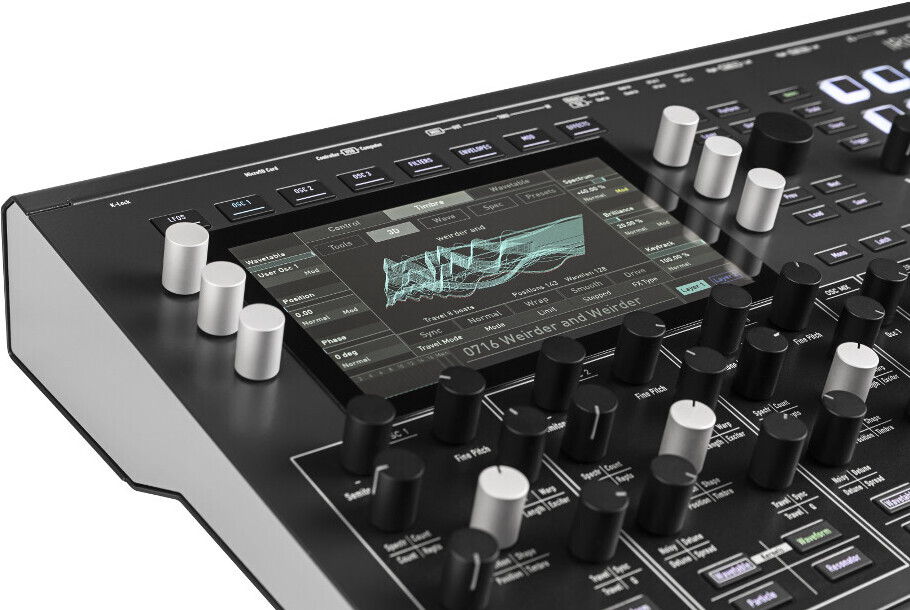
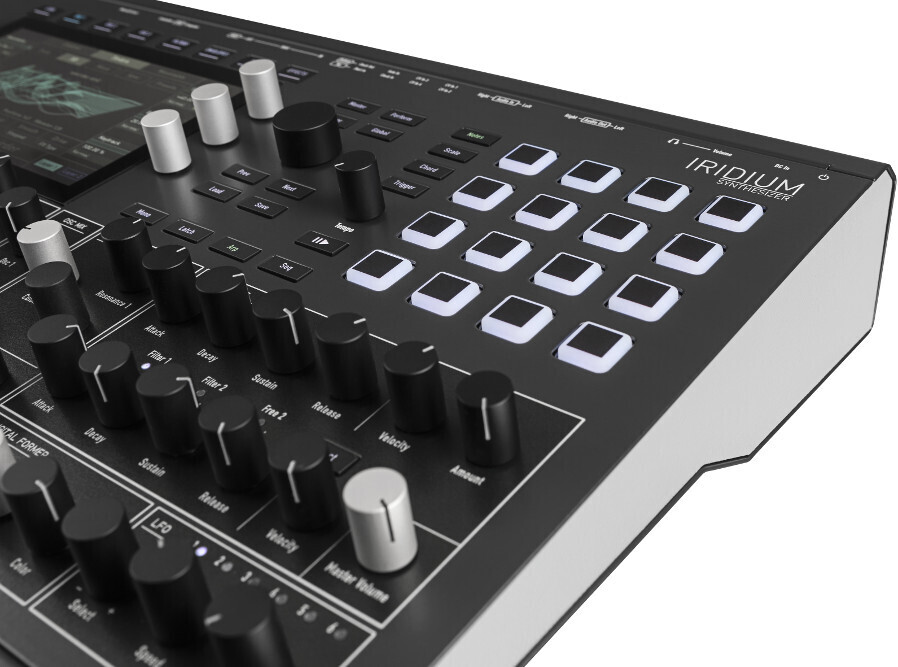
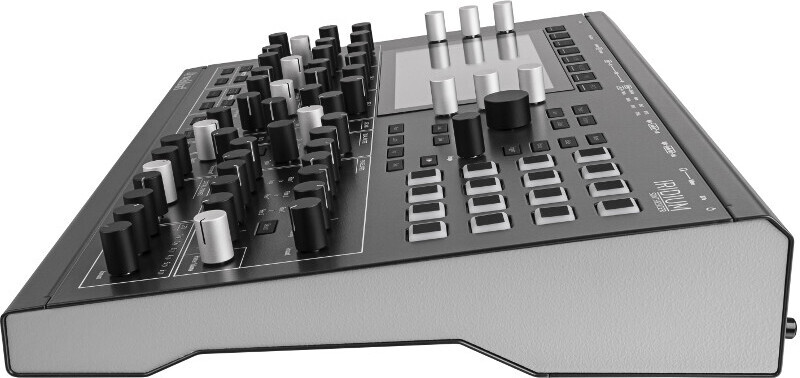
If the abundance of possibilities described here seems overwhelming, it’s good to know that the Waldorf Iridium is quite logical to use, easily approachable, and the main controls have dedicated knobs. The large plasma touchscreen and 4×4 silicone matrix, along with 7 assignable knobs combined with short menu paths, significantly improve usability.
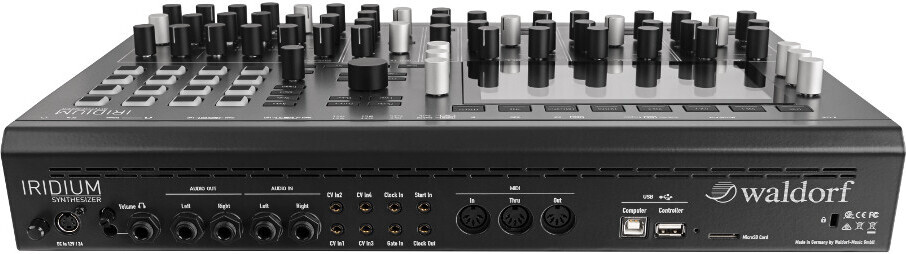
Waldorf Iridium has two audio outputs and two audio inputs for processing external signals, four CV control voltage inputs, as well as gate and trigger inputs. MIDI signals pass through both DIN and USB ports, and there are dedicated connectors for clock input and output. Data can be transferred not only via the MicroSD card slot but also through the USB host port, which can manage MIDI devices.
Waldorf Iridium is designed, manufactured, and assembled in Germany from the best possible components under very demanding and precise quality control. Its sound has been shaped by a group of world-class sound designers. The result is an extremely powerful synthesizer that maintains its usability for a long time.
Features:

The well-known massive, orchestral wavetable sounds that defined the entire 1980s soundscape and broke down the barriers between classical music, chart-topping hits, entertainment, and film music are now available with all the modern features and in a compact rack-size package: the Waldorf Iridium! Iridium is part of Waldorf's legacy, which began with the PPG Wave, but at the same time, it is one of those versatile modern synthesizers that master all synthesis forms with ease and can combine them in ways previously unimaginable. It is like the flagship Waldorf Quantum model, but a smaller and more convenient module that fits into a rack or on a tabletop.
Waldorf Iridium offers five different synthesis types for each of its three oscillators:
- Its own original wavetables, of course in an expanded and enhanced version
- Virtual analog, meaning classic oscillator-based waveforms, also thickened by combining multiple waves
- Sampling and granular sampling with both traditional sample functions and multisamples
- Resonator for demanding, virtual sound sculpting into shape
- Modular Kernel synthesis, where up to six audio cores can be freely combined into a single oscillator
Kernel synthesis was first introduced in the Quantum operating system update 2.0, and with it, each oscillator can be divided into six sub-oscillators that are then linked via FM synthesis as audio. This is already an impressive new instrument in itself, whose usage possibilities are still being explored. Waldorf Iridium has 7,000 memory slots, fully compatible with Quantum. Each voice has three digital filters: two freely linkable in the Dual Filter section and one in the Digital Former section. These include low-pass filters with overdrive, Nave, Largo, PPG 3V, as well as more unusual filters like Comb, Drive, and Bitcrusher. All filters preserve a natural, authentic stereo image throughout the signal path.
The modulation matrix with 40 slots can be controlled by much more than six envelopes and six LFOs. Each slot can be assigned a separate control value, and modulations can be routed to almost anything that can be expressed numerically. Internal inputs and outputs can be reused repeatedly until the matrix is full. And if the LFO or envelope runs out, the Komplex Modulator is available for creating new filter shapes.
If the abundance of possibilities described here seems overwhelming, it’s good to know that the Waldorf Iridium is quite logical to use, easily approachable, and the main controls have dedicated knobs. The large plasma touchscreen and 4x4 silicone matrix, along with 7 assignable knobs combined with short menu paths, significantly improve usability.
Waldorf Iridium has two audio outputs and two audio inputs for processing external signals, four CV control voltage inputs, as well as gate and trigger inputs. MIDI signals pass through both DIN and USB ports, and there are dedicated connectors for clock input and output. Data can be transferred not only via the MicroSD card slot but also through the USB host port, which can manage MIDI devices.
Waldorf Iridium is designed, manufactured, and assembled in Germany from the best possible components under very demanding and precise quality control. Its sound has been shaped by a group of world-class sound designers. The result is an extremely powerful synthesizer that maintains its usability for a long time.
Features: